Why the Word Lucky Cannot Explain a Game
Why the word lucky cannot explain a game: distinguish chance, skill and storytelling so classroom discussion can move from labels to how a game works.
Calling a game lucky tells you little about what its players do, what its rules allow, or how its outcome is produced. In a university discussion of casino culture, the word can describe chance, praise a person, excuse a loss, or serve a story; those are different claims, even when they arrive in the same sentence.
That distinction matters at Đại học Tây Đô, where students might encounter casino games through film, fiction, journalism, or cultural analysis rather than through play. The useful question is not whether luck is real. It is which job the word is doing, and whether that job answers the question at hand.
What does “lucky” mean in a conversation about games?
In ordinary conversation, “lucky” can point to at least three things. It can refer to an outcome shaped by chance, describe a person who seems to benefit repeatedly, or offer a compact explanation for an event whose causes the speaker has not examined. A storyteller may use it for a fourth purpose: to make a character’s success feel surprising or deserved.
These meanings overlap, but they are not interchangeable. “The result was lucky” is a comment about an outcome. “She is lucky” turns that outcome into a description of a person. “He won because he was lucky” proposes a cause. Each sentence asks a different follow-up question.
For game analysis, keep the label separate from the mechanism. A game’s rules describe what actions are possible and how outcomes are determined. Luck is a broad conversational category that may gesture toward uncertainty, but it does not specify the rules, the choices available, or the relation between them.
Is luck a feature of the rules or a story about the result?
Sometimes “luck” is a loose way to name uncertainty built into an outcome. A shuffled deck, a randomly selected result, or an unpredictable event in a fictional game can make a player’s next position uncertain. The exact source of uncertainty depends on the game’s rules and on how the scene presents them.
But a label still does not explain how the uncertainty operates. It does not tell you which outcomes are possible, how a player’s choice matters, or whether the story is showing random change, hidden information, or a character’s misreading of events. Those details belong to a description of the game, not to the word “lucky.”
At other times, luck is retrospective storytelling. A character succeeds, and an observer calls the result luck because the success looked unlikely or unexpected. That may be a reasonable reaction, but it is not proof that the character had no influence. A scene can show careful choices, a chance event, or both, while the dialogue reduces everything to one convenient word.
Which three approaches help separate the meanings?
There are three useful approaches: examine the game mechanism, read the label as social language, or analyze its storytelling function. Each suits a different task. None requires treating “luck” as a technical explanation when the speaker is using it casually.
How do you analyze luck as a game mechanism?
Use this approach when the discussion asks how a game works. Identify what the rules specify, what choices players can make, and what remains uncertain; then describe each plainly rather than substituting “luck” for the missing detail.
What does calling a player lucky do socially?
Use this approach when the word is praise, teasing, envy, or an excuse after a result. Ask who says it, what they want the label to convey, and whether it shifts attention away from choices or circumstances.
How does luck function in a story?
Use this approach for films, fiction, or other narrative material. Notice whether the label makes a win feel comic, suspicious, deserved, or arbitrary, and compare that effect with what the scene actually shows.
Which approach should a classroom discussion choose?
Choose according to the claim being examined: mechanism for rules, social language for conversation, and storytelling for narrative effect. If a passage mixes them, separate its claims rather than forcing one approach to answer every question.
How can a label be separated from an account?
A practical discussion can move from the word to the evidence in a short sequence:
- Quote the claim. Keep the exact phrase, such as “he got lucky,” so the discussion does not quietly replace what was said.
- Identify its job. Is it describing uncertainty, praising or blaming a person, or shaping a story’s tone?
- Name the missing information. A claim about a game may leave out the rules, the player’s choices, the event that changed the result, or the speaker’s reason for using the label.
- Describe what is shown. In a scene, separate visible actions and stated rules from an observer’s interpretation.
- Restate the claim precisely. Say what the evidence supports and leave unresolved questions unresolved.
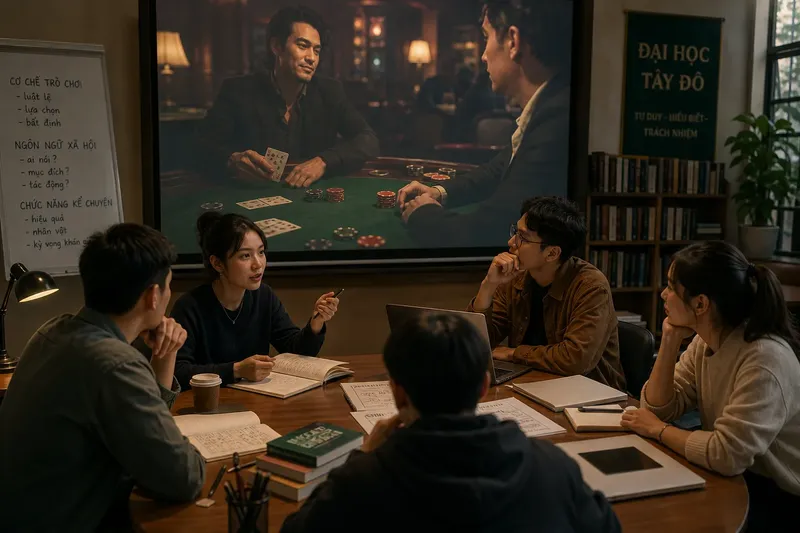
Imagine a film scene in which a fictional card player wins after choosing to stay in the hand, and a companion says, “You’re lucky.” The starting point is a successful outcome and a brief comment; the action in discussion is to ask whether the line refers to uncertainty, the player’s decision, or the companion’s attitude. The expected observable result is a more precise account of the scene: students can distinguish what happened from what the companion thinks it means, without inventing rules the film never provides.
This is especially useful in a mixed seminar. One student may focus on rules, another on character, and a third on dialogue. Asking each to identify the evidence for their interpretation gives them a shared object of discussion without pretending that one reading automatically settles the others.
Who benefits from each approach, and how do you choose?
Mechanism analysis suits readers who need to explain a game’s operation, compare rules, or assess a claim about how an outcome came about. It requires enough information about the game to make that account possible. If a story withholds the rules, the careful answer may be that the mechanism cannot be established from the scene.
Social-language analysis suits a discussion focused on how people talk about winning and losing. It can reveal whether “lucky” is generous, dismissive, self-protective, or playful. It does not, by itself, establish how the game works.
Story analysis suits students examining characterization, tone, or audience expectations. A writer’s use of “luck” can make an outcome feel sudden or raise questions about merit. The relevant evidence is how the word fits the scene, not whether the character’s luck can be independently calculated.
To choose, start with the question you need to answer. If it asks what produces an outcome, examine the rules and available information. If it asks what a speaker means, examine the exchange. If it asks what a scene leads viewers to feel or infer, examine its narrative choices. When a prompt includes more than one question, answer each on its own terms.
What is not worth the effort is arguing over whether a character is “truly lucky” before establishing what anyone means by the word. That debate often turns into competing intuitions. A sentence that names the observable event and the speaker’s interpretation is usually more useful.
Can “lucky” be useful without being an explanation?
Yes. The word can make a conversation quick, communicate a reaction, or carry a story’s tone. A character who calls a stranger lucky may be admiring them, resenting them, or trying to make a surprising result feel simple. Those functions are worth analyzing precisely because the word leaves much unsaid.
For a class at Đại học Tây Đô, a productive distinction is between using “lucky” as an interpretation and presenting it as an account. The first can be the subject of discussion: who says it, and what does the label do? The second needs support from the game’s rules and the details of the event. If those details are absent, the claim should remain a label rather than being dressed up as an explanation.
Keep that distinction in view the next time a casino scene turns on a “lucky” win. Ask what the game permits, what the character chooses, and what the word adds to the exchange. The scene may offer an answer to one of those questions and leave the others open; that is not a flaw in the discussion. It is a reason to be precise.