How Casinos Became Cultural References Beyond the Gaming Room
Trace how casinos became cultural references beyond gambling, from public leisure venues to metaphors of risk and spectacle, with a method for comparing sources.
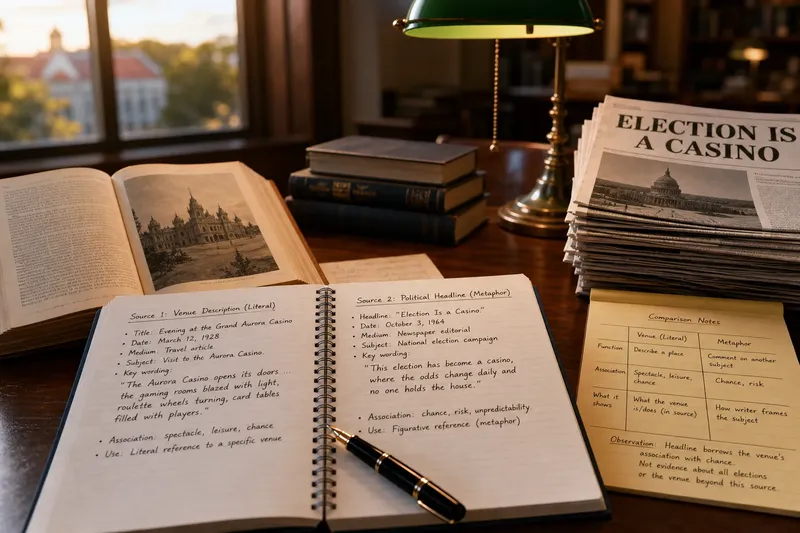
Casinos became cultural references when writers and speakers carried their images beyond gambling venues. At Đại học Tây Đô, comparing those uses across time can show how a place associated with leisure and play also became shorthand for risk, spectacle, or chance.
The shift is not a neat march from one meaning to another. A reference can retain older associations even as a new use takes hold, so the useful historical question is what a particular source borrowed—and what it left behind.
How did the casino reference change over time?
In an account focused on a venue, “casino” names a place and its activities. In a figurative use, it can describe something unrelated to gambling: a writer might call a political contest “a casino” to suggest that chance or risk dominates. The metaphor draws meaning from the venue, but it is not evidence about one.
That distinction matters when tracing change. A historical account of a specific place can document how its author describes that venue. A novel, editorial, or speech using the word figuratively can show how the reference worked in that source. Placing such materials beside each other can reveal a shift in usage without pretending that one source speaks for an entire period.
Do not assume that every later metaphor grew directly from a particular earlier venue. Unless sources establish that connection, describe the resemblance—such as a shared association with risk—rather than inventing a chain of influence.
What should a comparison actually establish?
Choose sources that make a meaningful comparison possible. A venue description and a political metaphor can be compared to ask how the word functions in each, but they cannot answer the same question about lived experience. A source’s date, medium, speaker, audience, and subject help explain what kind of evidence it offers.
Use this set of checks before making a historical claim:
- Specific wording: Check whether the source uses “casino” literally or figuratively; if it names a venue or describes its activities, discuss a place, and if it applies the word to another subject, analyze a figurative use.
- Date and setting: Check when and where the source was produced; if those details are available, include them in the comparison, and if they are missing, avoid claiming that the use represents a particular time or place.
- Speaker and audience: Check who uses the reference and for whom; if they are identifiable, describe that perspective, and if they are not, keep the claim attached to the text rather than a presumed audience.
- Surrounding subject: Check what the passage is discussing; if it concerns gambling or a venue, read the reference in that context, and if it concerns another subject, explain the metaphor without treating it as a venue record.
- Associated idea: Check which associations the wording supports, such as chance or spectacle; if one is clear, name it, and if several remain plausible, preserve the ambiguity.
- Comparison basis: Check whether both sources answer the same historical question; if they do, compare their usage, and if they do not, narrow the claim to what each source can show.
- Claim size: Check how many sources support the proposed pattern; if the evidence concerns one text, make a claim about that text, and if the comparison draws on several sources, state their shared limits.
Say a student at Đại học Tây Đô has two invented classroom materials: a venue description that names one casino, and a fictional campaign headline calling an election “a casino.” The student records the first as a literal reference and the second as a metaphor, then compares their wording and contexts. The resulting observation is that the headline borrows the venue’s association with chance; it does not establish that elections were generally described that way, or tell us what the named venue was like beyond what its description says.
How can you trace casino references through historical sources?
- Select a question: Decide whether you are tracing a venue, a figurative use, or a change between the two; if the question combines them, separate the parts before drawing conclusions.
- Record each source: Note the wording, date, medium, speaker if known, and subject; if key details are absent, mark them as unknown rather than filling the gaps.
- Classify the use: Decide whether “casino” names a place or works as a comparison; if the text supports both readings, state that uncertainty.
- Identify the association: Explain what the reference evokes in that passage; if the surrounding language does not clarify the association, limit the interpretation to the wording itself.
- Compare like with like: Set sources beside each other only for a question they can both address; if their purposes differ, describe the difference instead of treating them as equivalent evidence.
- Write the narrowest supported claim: State what the sources show and what they do not; if they document only particular uses, do not turn those uses into a claim about everyone or every venue.
Which questions help with casino references?
What is a casino reference in a text?
It is a word, image, or idea associated with a casino that a source uses to discuss a place or another subject. The surrounding passage helps distinguish a venue description from a metaphor.
Can a metaphor reveal what a real casino was like?
Not by itself. It can show how a writer frames another subject, while claims about a venue need sources that describe that place and its context.
How can you tell whether two sources show a historical shift?
Check their dates, settings, purposes, and uses of the word before comparing them. If one describes a venue and the other uses a metaphor, the comparison can show a change in function, but not necessarily explain how or why it occurred.
What can an incomplete source establish?
It may establish that a particular text used “casino” in a particular way, if the wording is clear. Missing context limits claims about the source’s audience, wider circulation, or the history of actual venues.
What is not worth the effort?
It is not worth assigning one permanent symbolic meaning to every use of “casino.” A metaphor may rely on chance in one passage and spectacle in another; reading the wording and its setting is more useful than forcing both into a single definition.
At Đại học Tây Đô, a study of casinos as cultural references can keep two histories in view without confusing them: the history of places and practices, and the history of language that borrows their associations. Near the end of any comparison, ask whether the sources support a claim about a specific use, a documented contrast, or a broader pattern; choose the smallest claim the evidence can carry.
That boundary is useful, not merely cautious. It points to the next source to seek: one that can clarify the missing date, venue, audience, or link between two uses, rather than another passage that only repeats the metaphor.