Planning a Casino Film Discussion for a Mixed Group
Plan a casino film discussion around one scene, with clear context and prompts that help a mixed group examine how editing, sound, and framing shape meaning.
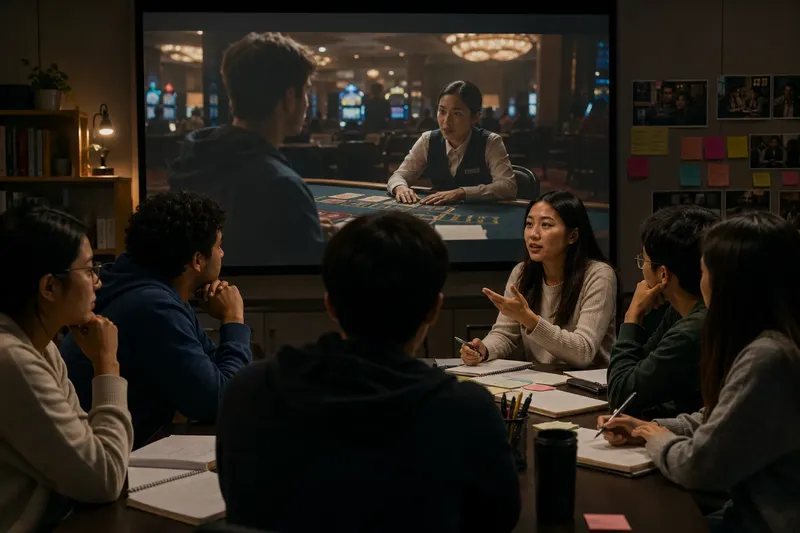
A casino film discussion gets sharper when the group examines how a scene assigns attention, authority, and point of view. At Đại học Tây Đô, that focus keeps the conversation on what the film constructs, rather than asking participants to generalize about casinos or disclose personal experience.
For a mixed group, access and context matter as much as the prompt. A scene should be understandable to someone who has not seen the whole film, and participants should be able to contribute by speaking, writing, listening, or passing.
What does the scene ask viewers to notice?
Choose a moment in which the film’s form shapes the story: perhaps a cut leaves one character’s response unseen, background sound fades as a negotiation begins, or a wide shot makes the casino floor seem more important than the people in it. Ask what the scene invites viewers to notice and whose perspective organizes that attention.
This is not a test of whether the scene accurately represents casino life. It is an inquiry into a specific creative choice and its effect within the story. Students can support an interpretation by pointing to a shot, line, edit, sound cue, or omission; they need not know game rules.
How can you prepare the excerpt for different viewers?
Before class, identify the scene by title and timestamp, check that the planned viewing method is authorized and accessible, and write one sentence of plot context. Then decide what participants can do if the excerpt is unfamiliar, the terminology is distracting, or speaking aloud is not comfortable.
- If the scene needs several plot events to make sense: Check how much context it requires; if one sentence is enough, provide it, but if the scene still depends on a long explanation, choose a more self-contained excerpt.
- If some participants have not seen the film: Check whether they can identify who is present and what is happening; if they can, begin with visible details, but if they cannot, give only the missing context before viewing.
- If game terminology appears: Check whether understanding the term is necessary to discuss the film’s framing; if it is, define that term briefly, but if it is not, set the terminology aside and focus on the scene’s choices.
- If viewing access differs across the group: Check which authorized accessible formats are available; if one meets the group’s needs, offer it, but if none is workable, provide a concise scene description and adjust the discussion task.
- If the first responses come from the same few people: Check whether everyone has had time to form an observation; if not, give participants a quiet writing pause, but if the discussion remains uneven, ask pairs to compare notes before sharing.
- If a participant prefers not to speak about gambling-related material: Check whether writing, listening, or passing is an explicit option; if not, state those choices without requesting a reason, but if another format is needed, offer an accessible alternative where possible.
- If conversation turns into claims about real casino visitors: Check whether the scene itself establishes the claim; if it does not, return to a specific character or filmmaking choice, but if the group wants to discuss real-world questions, separate that conversation from analysis of the film.
A glossary is not worth preparing when the selected scene does not depend on game terms. It can turn a discussion of a camera cut into an unexpectedly earnest vocabulary exercise.
Which prompts connect form to meaning?
Ask for an observation before asking for an interpretation. That small sequence helps distinguish what is on screen from what a viewer infers.
- Who receives the camera’s attention, and who remains at the edge of the scene?
- What changes when the soundtrack becomes louder, quieter, or absent?
- Does the editing make a choice feel deliberate, rushed, or uncertain?
- How does the setting function in this moment: workplace, performance space, marker of status, or background?
- What does the scene leave unexplained, and how might that omission shape a viewer’s judgment?
Say a class selects an invented scene in which a newcomer listens while a casino employee explains a rule. The facilitator supplies the starting context that the two characters have just met, then asks each participant to note who speaks, whose face the camera shows during the explanation, and what the background sound does. If the camera stays on the employee while the newcomer’s reaction is withheld, the group can decide that the scene gives the employee temporary authority; if it cuts between both faces, they can instead discuss how the exchange distributes attention. The observable result is a supported interpretation of this scene’s point of view, not a conclusion about how real employees or visitors behave.
What questions come up during discussion?
How much of the film should the group watch?
One scene can support discussion when the question concerns a choice visible in that moment. If the question depends on a pattern across the film, provide enough context to identify that pattern without turning the session into a plot recap.
What should you do if the excerpt is hard to follow?
Explain the relationship or event needed to understand the scene in a neutral sentence. If that cannot make the excerpt clear, select a different moment rather than supplying a running commentary.
How can disagreement stay productive?
Ask each person to point to the detail behind their interpretation, then compare what the scene emphasizes. Readings can differ without one having to win; the screen is not a witness stand.
How should the facilitator respond to gambling-strategy talk?
Redirect the group to how the film depicts risk, choice, or status, rather than treating the scene as instruction. Keep broader real-world questions separate from film analysis and avoid offering personal or professional advice.
What should the facilitator leave ready?
Prepare the scene reference, one context sentence, and prompts tied to details the group can see or hear. Confirm how participants can access the excerpt and state their options for contributing. A short written record of the interpretations and the details supporting them can give the next class a useful starting point without pretending the film settled a broader question.
For a focused casino film discussion, the most useful closing question is often which filmmaking choice shaped the group’s reading and what scene detail supports that answer. Keep the record specific: note the shot, sound, edit, or line under discussion, so the next conversation begins with evidence on screen rather than a memory that has acquired its own soundtrack.